Red panda
From Wikipedia, the free encyclopedia
Red panda[1]
Conservation status
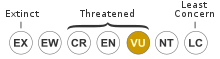
Vulnerable (IUCN 3.1)[2]
Scientific classification
Kingdom: Animalia
Phylum: Chordata
Class: Mammalia
Order: Carnivora
Suborder: Caniformia
Infraorder: Arctoidea
Superfamily: Musteloidea
Family: Ailuridae
Genus: Ailurus
F. Cuvier, 1825
Species: A. fulgens
Binomial name
Ailurus fulgens
F. Cuvier, 1825
Subspecies
A. f. fulgens
A. f. refulgens syn. A. f. styani[1]

Red panda range
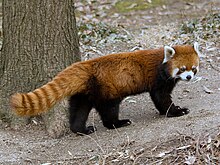
The red panda (Ailurus fulgens), also called red bear-cat and lesser panda, is a small arboreal mammal native to the eastern Himalayas and southwestern Chinathat has been classified as Vulnerable by IUCN as its wild population is estimated at less than 10,000 mature individuals. The population continues to decline and is threatened by habitat loss and fragmentation, poaching, and inbreeding depression, although red pandas are protected by national laws in their range countries.[2]
The red panda is slightly larger than a domestic cat. It has reddish-brown fur, a long, shaggy tail, and a waddling gait due to its shorter front legs. It feeds mainly onbamboo, but is omnivorous and also eats eggs, birds, insects, and small mammals. It is a solitary animal, mainly active from dusk to dawn, and is largely sedentaryduring the day.
The red panda is the only living species of the genus Ailurus and the family Ailuridae. It has been previously placed in the raccoon and bear families, but results ofphylogenetic research indicate strong support for its taxonomic classification in its own family Ailuridae, which along with the weasel family is part of the superfamilyMusteloidea.[3] Two subspecies are recognized.[1]
Contents
1 Physical characteristics
2 Distribution and habitat
2.1 Distribution of subspecies
3 Biology and behavior
3.1 Behavior
3.2 Diet
3.3 Reproduction
4 Threats
5 Conservation
5.1 In situ initiatives
5.2 In captivity
6 Domestication
7 Phylogenetics
7.1 Evolutionary history
8 Taxonomic history
9 Local names
10 Cultural depictions
11 Footnotes
12 References
13 Further reading
14 External links
Physical characteristics[edit]

 Red panda descending head first
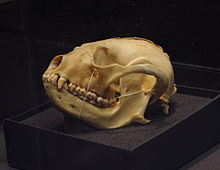 Red panda skull
The head and body length of red pandas measures 50 to 64 cm (20 to 25 in), and their tail is 28 to 59 cm (11 to 23 in). Males weigh 3.7 to 6.2 kg (8.2 to 14 lb) and females 3 to 6.0 kg (6.6 to 13 lb).[4][5][6] They have long, soft reddish-brown fur on the upper parts, blackish fur on the lower parts, and a light face with tear markings and robust cranial-dental features. The light face has white badges similar to those of a raccoon, but each individual can have distinctive markings. Their roundish head has medium-sized upright ears, a black nose, and very dark eyes: almost pitch black. Their long bushy tail with six alternating yellowish red transverse ochre rings provides balance and excellent camouflage against its habitat of moss- and lichen-covered trees. The legs are black and short with thick fur on the soles of the paws. This fur serves as thermal insulation on snow-covered or ice surfaces and conceals scent glands which are also present on the anus.[7]
The red panda is specialized as a bamboo feeder with strong, curved and sharp semi-retractile claws[4] standing inward for grasping of narrow tree branches, leaves and fruit. Like the giant panda, it has a “false thumb” that is an extension of the wrist bone. When descending a tree headfirst, the red panda rotates its ankle to control its descent, one of the few climbing species to do so.[8]
Distribution and habitat[edit]
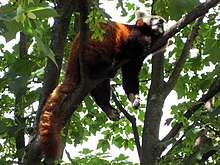 Red panda sleeping
The red panda is endemic to the temperate forests of the Himalayas, and ranges from the foothills of western Nepal toChina in the east.[9] Its easternmost limit is the Qinling Mountains of the Shaanxi Province in China. Its range includes southern Tibet, Sikkim and Assam in India, Bhutan, the northern mountains of Burma, and in southwestern China, in theHengduan Mountains of Sichuan and the Gongshan Mountains in Yunnan. It may also live in southwest Tibet and northernArunachal Pradesh, but this has not been documented. Locations with the highest density of red pandas include an area in the Himalayas that has been proposed as having been a refuge for a variety of endemic species in the Pleistocene. The distribution range of the red panda should be considered disjunct, rather than continuous.[4] A disjunct population inhabits the Meghalaya Plateau of northeastern India.[10]
During a survey in the 1970s, signs of red pandas were found in Nepal's Dhorpatan Hunting Reserve.[11] Their presence was confirmed in spring 2007 when four red pandas were sighted at elevations ranging from 3,220 to 3,610 m (10,560 to 11,840 ft).[12] The species' westernmost limit is in Rara National Park located farther west of the Dhorpatan Hunting Reserve.[13] Their presence was confirmed in 2008.[14]
The red panda lives between 2,200 and 4,800 meters (7,200 and 15,700 ft) altitude, inhabiting areas of moderate temperature between 10 and 25 °C (50 and 77 °F) with little annual change. It prefers mountainous mixed deciduous and conifer forests, especially with old trees and dense understories of bamboo.[4][9]
The effective population size of the Sichuan population is larger and more stable than that of the Yunnan population, implying a southward expansion from Sichuan to Yunnan.[15]
The red panda has become extirpated from the Chinese provinces of Guizhou, Gansu, Shaanxi and Qinghai.[16]
Distribution of subspecies[edit]
Distribution of the red panda is disjointed, with two extant subspecies:
Western red panda A. f. fulgens (Cuvier, 1825) lives in the western part of its range, in Nepal, Assam, Sikkim and Bhutan
Styan's red panda A. f. styani lives in the east-northeastern part of its range, in southern China and northern Burma.[17]
Ailurus fulgens styani has been described by Thomas in 1902 based on one skull from a specimen collected in Szechwan.[18] Pocock distinguished A. f. styani from A. f. fulgens by its longer winter coat and more abundant blackness in the pelage, bigger skull, more strongly curved forehead, and more robust teeth. His description is based on skulls and skins collected in Szechwan, Myitkyina close to the border of Yunnan, and Upper Burma.[7]
The Styan's red panda is supposedly larger and darker in color than its Western conspecific, but with considerable variation in both subspecies, and some individuals may be brown or yellowish brown rather than red.[9]
The Brahmaputra River is often considered the natural division between the two subspecies, where it makes a curve around the eastern end of the Himalayas, although some authors suggest A. f. fulgensextends farther eastward, into China.
Biology and behavior[edit]
Behavior[edit]
Sounds of red panda twitteringThe red panda is territorial; it is solitary except during mating season. The species is generally quiet except for some twittering, tweeting, and whistling communication sounds. It has been reported to be both nocturnal and crepuscular, sleeping on tree branches or in tree hollows during the day and increasing its activity in the late afternoon and early evening hours. It sleeps stretched out on a branch with legs dangling when it is hot, and curled up with its tail over the face when it is cold.[4] This panda is very heat sensitive, with an optimal “well-being” temperature between 17 and 25 °C (63 and 77 °F), and cannot tolerate temperatures over 25 °C (77 °F).
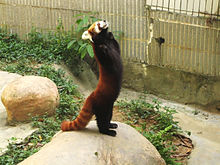 Red panda standing
Shortly after waking, red pandas clean their fur like a cat, licking their front paws and then rubbing their backs, stomachs and sides. They also rub their backs and bellies along the sides of trees or rocks. Then they patrol their territories, marking with urine and a weak musk-smelling secretion from their anal glands. They search for food running along the ground or through the trees. Red pandas may alternately use their forepaws to bring food to their mouths or place food directly into their mouths.[4]
Predators of the red panda include the snow leopard, martens (Mustelidae), and humans. If they feel threatened or sense danger, they may try to escape by climbing a rock column or tree. If they can no longer flee, they stand on their hind legs to make themselves appear larger and use the sharp claws on their front paws to defend themselves. The red panda Futa became a visitor attraction in Japan for his ability to stand upright for ten seconds at a time.
Diet[edit]
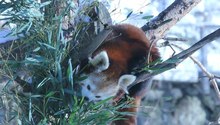 Red panda gnawing
Red pandas are excellent climbers, and forage largely in trees. They eat mostly bamboo, and may eat small mammals, birds, eggs, flowers and berries. In captivity, they were observed to eat birds, flowers, maple and mulberry leaves, and bark and fruits of maple, beech and mulberry.[4]
Like the giant panda, they cannot digest cellulose, so they must consume a large volume of bamboo to survive. Their diets consist of about two-thirds bamboo, but they also eat mushrooms, roots, acorns, lichen and grasses. Occasionally, they supplement their diets with fish and insects. They do little more than eat and sleep due to their low-calorie diets.[citation needed]
Bamboo shoots are more easily digested than leaves, exhibiting the highest digestibility in summer and autumn, intermediate digestibility in the spring, and lowest digestibility in the winter. These variations correlate with the nutrient contents in the bamboo. Red pandas process bamboo poorly, especially the cellulose and cell wall components. This implies microbial digestion plays only a minor role in their digestive strategy. To survive on this poor-quality diet, they have to eat the high-quality sections of the bamboo plant, such as the tender leaves and shoots, in large quantities, over 1.5 kg (3.3 lb) of fresh leaves and 4 kg (8.8 lb) of fresh shoots daily. This food passes through the digestive tract fairly rapidly (about 2–4 hr) so as to maximize nutrient intake.[19] Red pandas can taste artificial sweeteners, such as aspartame, the only known nonprimate known to do so.[20]
Reproduction[edit]
 Red panda cubs playing
Red pandas are able to reproduce at around 18 months of age, and are fully mature at two to three years. Adults rarely interact in the wild except to mate. Both sexes may mate with more than one partner during the mating season from mid-January to early March.[21] A few days before birth, females begin to collect material, such as brushwood, grass, and leaves, to build a nest, which is normally located in a hollow tree or a rock crevice. After a gestation period of 112 to 158 days, the female gives birth in mid-June to late July to one to four blind and deaf cubs weighing 110 to 130 g (3.9 to 4.6 oz) each.[4]
After birth, the mother cleans the cubs and can then recognize each by its smell. At first, she spends 60% to 90% of her time with the cubs. After the first week, the mother starts spending more time outside the nest, returning every few hours to nurse and groom the cubs. She moves the young frequently among several nests, all of which she keeps clean. The cubs start to open their eyes at about 18 days of age. By about 90 days, they have achieved full adult fur and coloring, and begin to venture out of the nest. They also start eating solid foods at this point, weaning at around six to eight months of age. The cubs stay with their mother until the next litter is born in the following summer. Males rarely help raise the young, and only if they live in pairs or in small groups.[4]
The average lifespan is between eight and 10 years, but individuals have been known to reach 15 years.


0 التعليقات:
إرسال تعليق